

.svg)
.svg)
Introduction
The contractor workforce isn't a niche category anymore. According to Staffing Industry Analysts citing MBO Partners, 72.9 million independent workers were active in the U.S. in 2025 — and that number keeps climbing. Across enterprises, GCCs, and product organizations, contractors now handle everything from platform engineering to compliance analysis.
Paying contractors is nothing like running standard employee payroll. There's no tax withholding, no W-2s — instead, you're managing W-9 collection, TIN validation, 1099-NEC filing, variable pay cycles, and multi-state tax rules that shift constantly.
The IRS projects 61.4 million Form 1099-NEC filings for 2026, up from 54.6 million in 2024. Miss a filing or misclassify a worker, and the penalties compound quickly.
This guide breaks down the best payroll services for contractors in 2026 — what each platform does well, where it falls short, and which fits your contractor volume and workforce structure.
TL;DR
- Contractor payroll requires purpose-built tools, not HR platforms with a contractor module tacked on
- The best platforms automate US 1099 filing, support fast payments, and integrate with existing HR and AP systems
- Your choice depends on contractor volume, geographic spread, and how much compliance automation you need
- Top picks for 2026: Gusto, ADP WorkMarket, Rippling, Remote, and Papaya Global
What Are Payroll Services for Contractors?
Contractor payroll services are specialized platforms designed for the variable, on-again-off-again nature of independent contractor work. They handle payment processing, W-9 collection, TIN validation, 1099-NEC generation and filing, and compliance gating — none of which standard employee payroll systems are built to manage well.
The core distinction from employee payroll: employers don't withhold income taxes or deduct benefits for contractors. The IRS defines an independent contractor as a worker where the payer controls only the result of the work — not what's done or how it's done.
Getting that classification wrong carries real exposure. Under the FLSA, misclassification can mean back pay, liquidated damages of equal value, and civil money penalties up to $2,515 per violation for repeated or willful offenses.
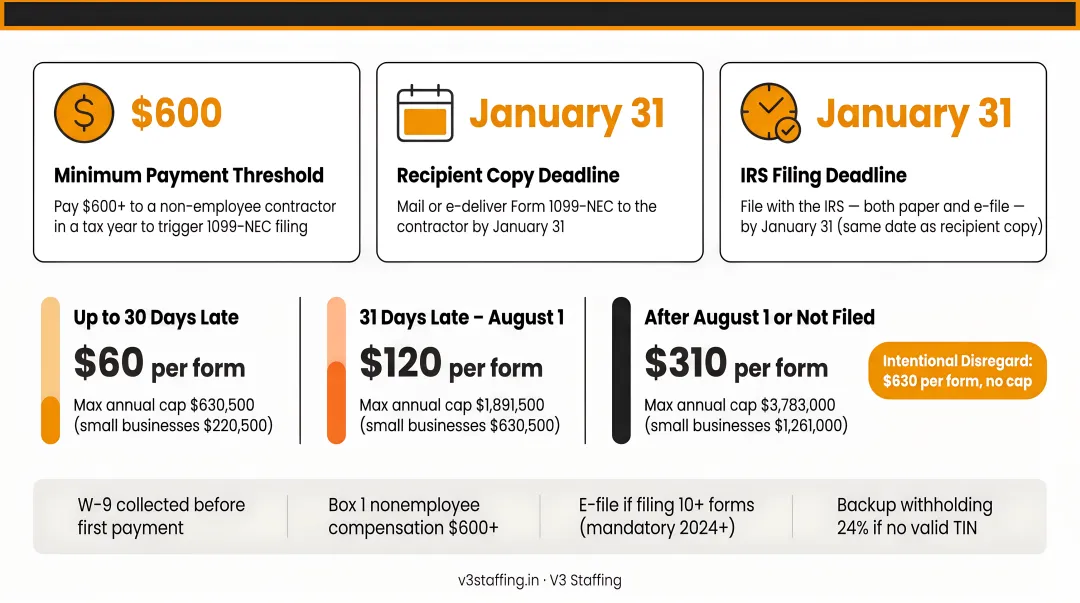
Key 1099-NEC compliance figures to know:
- Filing threshold: $600 or more in nonemployee compensation
- Deadline: January 31
- Late filing penalty: Up to $340 per return (filed after August 1)
- Intentional disregard penalty: Up to $680 per return
For organizations running contractor-heavy teams across IT, manufacturing, or GCC environments, choosing the right payroll service directly affects compliance exposure and payment reliability — which is why this decision deserves more than a quick vendor search.
Best Payroll Services for Contractors in 2026
The platforms below were evaluated across five criteria:
- Compliance automation and tax filing coverage
- Payment speed and method flexibility
- Integration depth with HR and finance systems
- Contractor self-service experience
- Suitability across different business sizes and geographies
Gusto
Gusto is a cloud-based payroll platform built for small businesses managing their first batch of contractors. Contractors submit their own W-9 and direct deposit details through a self-service portal, and Gusto handles 1099-NEC creation and e-filing automatically.
What sets it apart is simplicity. Teams without a dedicated HR function can get up and running quickly — no implementation consultant required. The contractor-only plan charges $35/month plus $6/contractor/month, with no fee for contractors in months they aren't paid.
ERP integration depth is limited, and Gusto's scalability plateaus at higher contractor volumes or more complex multi-state operations.
ADP WorkMarket
ADP WorkMarket is enterprise-grade contractor management built on ADP's broader ecosystem. It's designed for organizations managing a mixed workforce of W-2 employees and 1099 contractors, with a strong emphasis on governance, classification guardrails, and audit trails.
The Labor Clouds feature organizes pre-vetted contractor pools by skillset, geography, certifications, and business needs — making it practical for large teams sourcing specialized talent repeatedly. Automated tax ID and bank account verification, plus built-in 1099-NEC filing, reduce the manual compliance burden at scale.
Implementation timelines can be lengthy, the interface feels more traditional than newer API-first tools, and pricing requires a direct quote — worth factoring in before committing to a demo.
Rippling
Rippling connects HR, IT, and finance operations in a single platform. Contractors sit within a module alongside employees, triggering onboarding steps, payroll runs, and offboarding tasks automatically — with device management and app access provisioning handled in the same system.
Contractors can be onboarded in 185+ countries and paid in over 50 local currencies, with funds typically arriving 2–4 days after an approved pay run. Federal, state, and local tax filings — including 1099s — are covered on the pricing page.
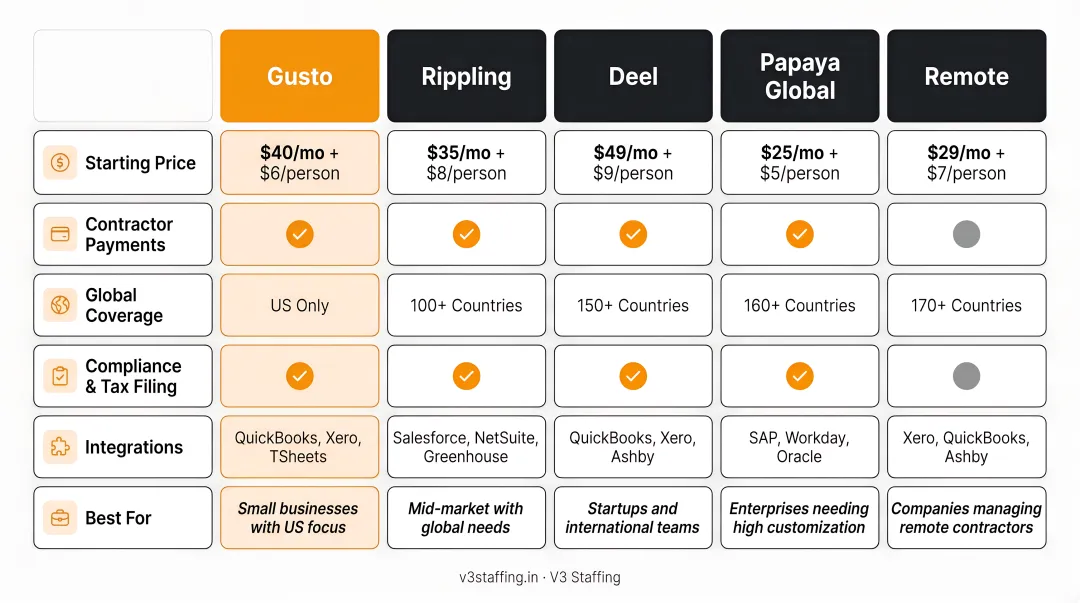
Where Rippling falls short: its contractor module doesn't match the depth of standalone platforms for complex, variable gig payment structures. It shines when you need one operating system for your entire workforce, not a specialist tool.
Remote
Remote is built specifically for distributed teams operating across borders. The platform supports contractor onboarding in over 190 countries, with payouts across 200+ jurisdictions in multiple currencies. In February 2025, Remote launched stablecoin payouts for contractors in nearly 70 countries, starting with USDC.
The standout differentiator is Contractor Management Plus, which includes misclassification indemnity coverage up to $100,000 per contractor and $1 million per client — meaningful protection for companies hiring across jurisdictions with inconsistent classification rules. Locally compliant contracts and IP protection are included by default.
Remote is less optimized for high-volume domestic U.S. contractor workflows where 1099 automation is the primary need.
Papaya Global
Papaya Global aggregates payroll data from local vendors into a unified strategic dashboard, covering 180+ countries and 130+ local payout currencies. Rather than acting as a single processor, it provides consolidated visibility across complex, multi-country contractor and employee payrolls.
Key differentiators: Papaya uses local payment rails (ACH, SEPA) instead of SWIFT to reduce cross-border transfer costs, and Worker Wallets allow contractors to hold balances in multiple currencies, spend via a connected Visa debit card, or withdraw directly to a bank account. The platform reports 95% same-day payments through these local rails.
Pricing starts at $5/contractor/month for the base Contractor Management plan — meaningfully lower than competitors at entry level — though the platform's complexity may exceed the needs of organizations with limited global operations.
How We Chose the Best Payroll Services for Contractors
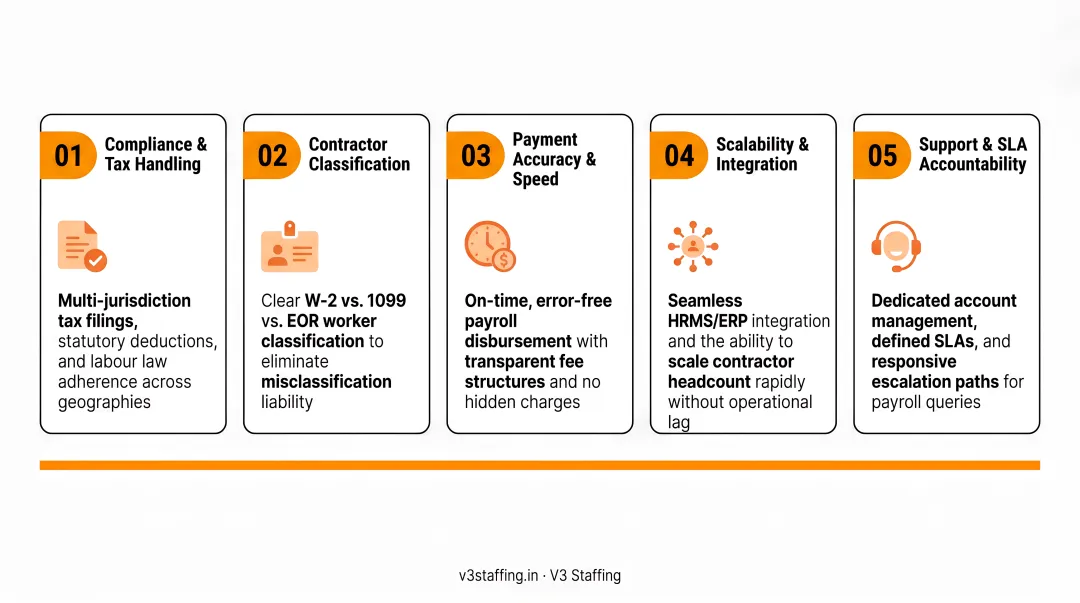
These platforms were evaluated across five dimensions:
- Compliance automation — Does it handle 1099-NEC filing, TIN validation, and W-9 collection without manual intervention?
- Payment speed — Does it support same-day or next-day ACH, or is the standard 2–4 day cycle the only option?
- Integration depth — Can it connect cleanly with existing HR, AP, and ERP systems?
- Contractor experience — Is onboarding self-service? Do contractors have visibility into payment status?
- Scalability — Does the platform hold up at 200+ contractors, or does it start showing cracks?
The Most Common Selection Mistake
The single biggest error organizations make: choosing a general employee payroll platform and trying to force-fit it for contractor use. The result is manual workarounds, missed 1099 filings, and misclassification liability. Contractor payroll requires purpose-built workflows — not just an added module that handles payments but ignores tax reporting or compliance gating.
Where a Staffing Partner Adds Value
Avoiding that mistake often means solving the pre-payroll layer first — before the platform ever processes a payment. Enterprises managing large contractor populations, particularly in compliance-heavy sectors like IT, manufacturing, and GCC environments, often pair their payroll platform with a staffing partner that handles sourcing, vetting, and onboarding compliance upstream.
V3 Staffing, which works with enterprises including Google, DuPont, Stellantis, and Johnson Controls, operates at that pre-payroll layer. With a 48–72 hour deployment model, V3 handles statutory compliance, background verification, and employment documentation before contractors reach the payroll system — reducing the volume of compliance issues the platform itself needs to catch.
Conclusion
Choosing the right contractor payroll platform comes down to three variables: contractor volume, geographic spread, and the compliance automation your team actually needs.
Start by identifying your biggest friction points — 1099 errors, slow payments, multi-state tax exposure, or misclassification risk — against the feature sets above. Prioritize platforms that will scale with your contractor workforce, not just handle today's headcount. A platform that works at 20 contractors often breaks at 200.
Scaling contractor headcount also means tightening the pipeline behind it. V3 Staffing works alongside your payroll platform to handle the contractor lifecycle — from sourcing and vetting through compliant onboarding — with SLA-driven delivery and 48–72 hour turnaround for contractor roles.