
.svg)
.svg)
Introduction
Hiring talent in a country where your company has no registered legal entity is technically illegal without the right employment vehicle in place. Yet many global expansion teams treat EOR (Employer of Record) compliance as a given, selecting providers based on country coverage lists without understanding what compliance actually requires in practice.
This article is written for HR leaders, GCC heads, and operations managers who need more than the concept.
EOR compliance is the legal and administrative framework through which an EOR assumes full employer obligations: payroll taxes, labor laws, statutory benefits, and contract requirements, on behalf of a client company hiring internationally. Understanding how it works helps you choose the right partner, spot hidden liability, and scale international hiring without surprises. This guide covers the mechanics of EOR compliance, what providers are actually responsible for, and where liability gaps tend to appear.
Key Takeaways
- An EOR becomes the legal employer in the destination country, taking on full liability for labor law compliance, payroll taxes, and statutory benefits
- EOR compliance spans tax registration, contracts, benefits, data privacy, and termination — all managed simultaneously
- Compliance starts before the first hire and requires ongoing adjustment as regulations change — not a one-time setup
- Real limits exist: permanent establishment risk, regulated sectors, and scale thresholds can make entity setup necessary instead
- Country coverage is not the same as compliance depth — in-country expertise is what makes the difference
What Is EOR Compliance in International Hiring?
EOR compliance is the set of legal, regulatory, and administrative obligations that an Employer of Record fulfills on behalf of a client company when employing workers in a foreign country. This includes adherence to that country's labour laws, tax codes, social contribution requirements, and employment standards.
The distinction from general HR outsourcing is significant. Unlike a staffing agency or PEO, the EOR holds legal employer status, which means compliance liability rests with the EOR, not the client. That's a genuine transfer of legal risk—one that changes how both parties are exposed to regulatory consequences.
The Dual-Control Structure
The EOR controls the compliance and employment relationship on paper. The client company controls day-to-day work direction and output. This division is legally significant in most jurisdictions because:
- The EOR is accountable to local tax authorities and labour regulators
- The client retains operational authority without triggering direct employer obligations
- Courts assess the actual working relationship when disputes arise—not just what the contract says
This is the structure V3 Staffing builds its EOR model around — full compliance ownership over payroll, statutory contributions, and the employee lifecycle, while clients retain complete control over the work itself.
Why EOR Compliance Matters for International Hiring
The stakes are higher than most companies anticipate. According to KPMG's 2025 payroll report, payroll inaccuracies cost organizations 2% to 5% of total annual payroll—and that's in domestic contexts with familiar rules. Cross-border payroll errors compound quickly when statutory rates, contribution ceilings, and filing frequencies vary by country.
What Goes Wrong Without Compliant Employment
- Payroll tax violations — missed filings, incorrect withholding, late remittances
- Invalid employment contracts — agreements that fail to meet local written-form requirements or exclude mandatory clauses
- Missed statutory benefits — failure to enroll workers in mandatory insurance or pension schemes
- Permanent establishment risk — the company unknowingly creates a taxable presence in the country
- Employment disputes governed by local courts under unfamiliar legal frameworks
Why Complexity Is Underestimated
Labor laws differ not just country-to-country but within countries. A few examples illustrate how quickly the variables multiply:
- India — state-level professional tax, state-specific Shops and Establishments Acts, and jurisdiction-varying leave entitlements
- Canada — province-level payroll and employment standards that differ significantly across regions
- UK — employer rates and thresholds revised every tax year, requiring annual recalibration
- Germany — strict written-form requirements that apply even to electronically delivered terminations
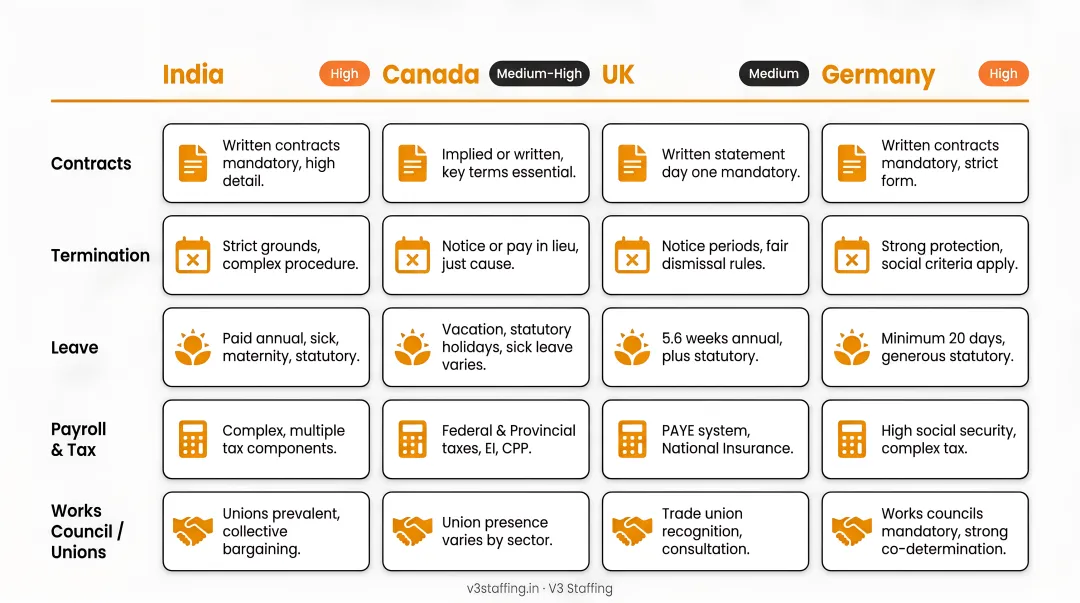
No single global template handles all of this. Getting it right in each market requires in-country expertise, not a one-size-fits-all policy.
How EOR Compliance Works: A Step-by-Step Breakdown
EOR compliance is a continuous, multi-stage process that begins before hiring, runs through the employment lifecycle, and concludes at offboarding. Each stage carries specific obligations.
Compliance Scoping and Country Registration
Before onboarding any employee, the EOR must confirm it has a registered legal entity or trusted in-country partner in the destination country. This is what makes legal employment possible.
Country-specific registration requirements vary considerably:
| Country | Registration Requirements |
| India | EPF registration for establishments with 20+ employees; ESI registration within 15 days of applicability; state shop registration within 90 days |
| UK | PAYE registration before the first payday; employer NI enrollment |
| Germany | Betriebsnummer (employer number) for social-security reporting; wage-tax process setup |
The scoping decision belongs before the offer letter goes out—not after.
Employment Contract Drafting and Localization
EOR compliance requires contracts written in accordance with local law, not adapted from generic templates. Mandatory clauses differ substantially across markets:
- India — appointment letters required under state shops laws; statutory rights waivers are null and void; one month's written notice required after three months of continuous service
- UK — written statement of employment particulars legally required; statutory notice scales from one week per year of service up to 12 weeks
- Germany — essential terms must be documented in writing; termination requires physical written form (electronic form is excluded by statute); social justification required after six months of service
A contract compliant in the UK may be legally invalid in Germany or unenforceable in India.
Payroll Setup, Tax Withholding, and Statutory Contributions
The EOR enrolls the employee with local tax authorities, calculates correct income tax withholding, remits employer-side social contributions, and issues legally required payslips. The contribution structures are specific and non-negotiable:
- India EPF — 12% employer + 12% employee on basic wages and dearness allowance
- India ESI — 3.25% employer + 0.75% employee (effective July 2019)
- UK National Insurance — 13.8% employer Class 1 secondary NIC above the secondary threshold for 2024–2025
- Germany — approximately 19–20% employer social burden across pension, health, unemployment, and long-term care contributions
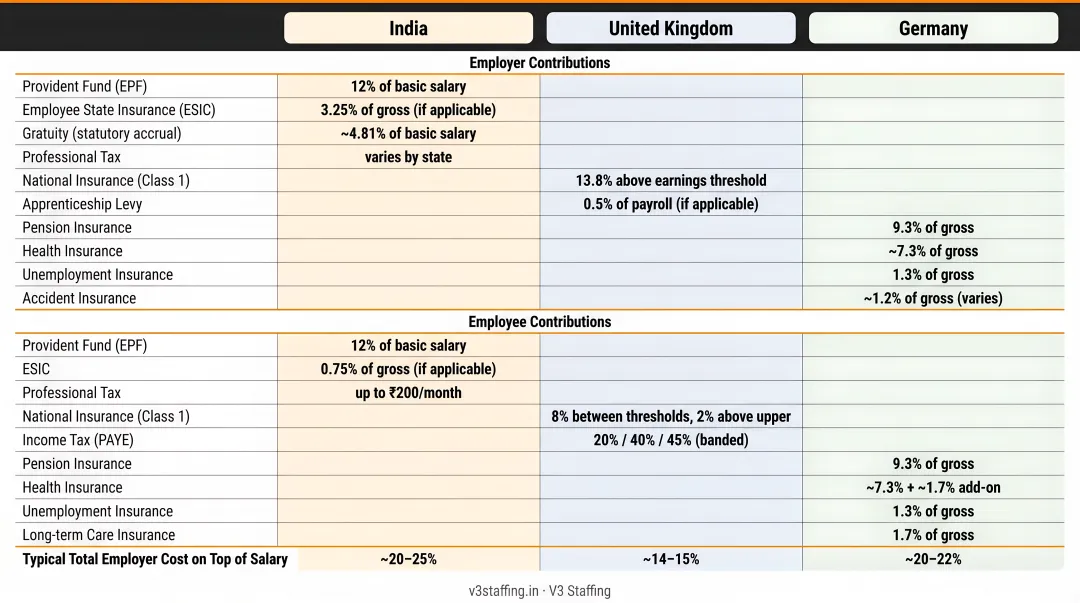
Errors in these calculations trigger audits and penalties. The UK alone imposes late PAYE penalties ranging from 1% to 4% for repeated defaults, with additional 5% surcharges after six and twelve months.
Ongoing Compliance Monitoring and Regulatory Updates
Those penalty figures are the cost of getting it wrong once. Avoiding them requires compliance to be treated as ongoing operations, not a one-time onboarding task. Labor laws change, minimum wages get updated, social contribution rates shift, and data privacy requirements evolve.
A competent EOR tracks these changes in real time and updates contracts, payroll calculations, and benefit structures accordingly. The update cadences vary by country:
- Germany — social security contribution figures change by reference date each year
- UK — new employer rates and thresholds published annually each tax year
- India — state-level professional tax and shop registration rules vary by jurisdiction and can change independently of central labor codes
V3 Staffing's compliance team monitors regulatory changes across India's major hiring markets — covering PF, ESIC, professional tax, TDS, gratuity, and maternity leave policies — and keeps practices aligned with both central and state-level requirements as rules evolve.
Key Compliance Areas an EOR Manages
Labor Law and Employment Standards
An EOR manages a wide band of employment obligations in each jurisdiction:
- Statutory leave entitlements and working hour limits
- Termination procedures and severance requirements
- Anti-discrimination obligations
Non-compliance with termination law is one of the costliest international compliance failures a company can face — particularly in Germany, where wrongful termination claims can invalidate dismissals entirely after six months of service.
Tax and Payroll Compliance
The EOR handles employer tax registration, income tax withholding at source, and remittance of both employer and employee contributions to state-mandated schemes. End-of-year tax filings, payslip issuance, and audit trail documentation are all part of the EOR's mandate. Payroll compliance errors are routinely flagged in cross-border audits — and they're rarely isolated findings.
Benefits Mandate Compliance
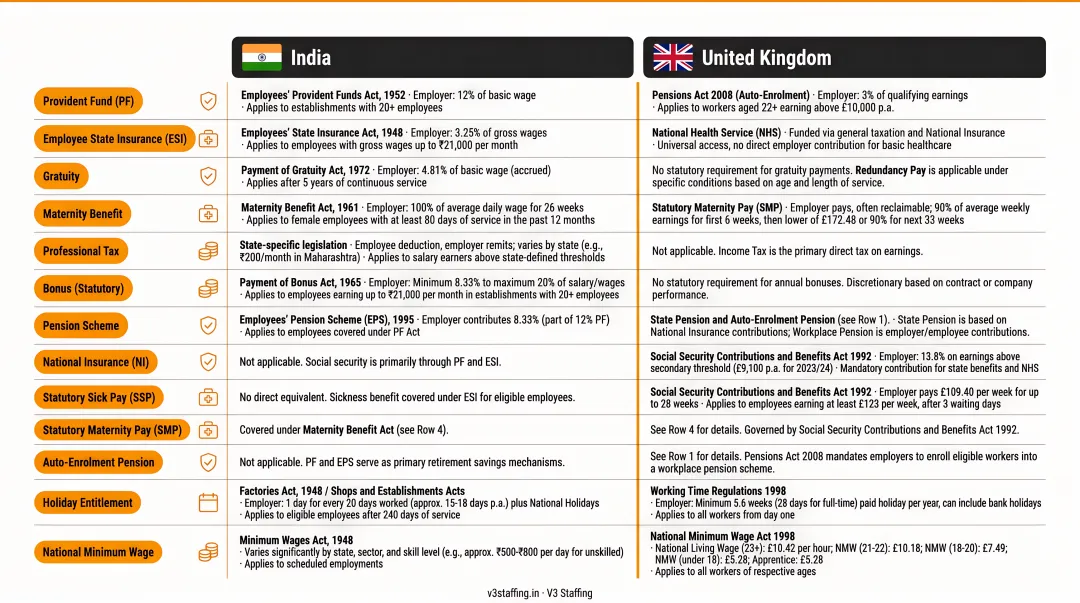
Statutory benefits are legally required—they are not negotiable additions. In India alone, a compliant EOR must administer:
- EPF contributions (12% employer rate)
- ESI coverage for eligible employees
- Gratuity entitlements after five years of continuous service under the Payment of Gratuity Act
- Maternity benefits under the Maternity Benefit Act for establishments with ten or more employees
In the UK, statutory sick pay stands at £123.25 per week for up to 28 weeks. Statutory maternity pay runs at 90% of average weekly earnings for six weeks, then £194.32 or 90% (whichever is lower) for 33 weeks. Each of these carries its own calculation method, eligibility threshold, and filing deadline — and regulators treat gaps as violations, not oversights.
Data Privacy and Employment Records
Hiring internationally triggers data protection obligations that affect how employee data is stored, processed, and transferred. GDPR's Chapter V requires a valid transfer basis for any personal data sent outside the EEA. India's Digital Personal Data Protection Act 2023 covers data processed within India — and extends to processing outside India when it's connected to services offered to individuals there.
EORs must maintain employment records that satisfy local audit requirements while respecting applicable data residency rules. Both obligations run concurrently; neither can be deprioritised.
Common EOR Compliance Misconceptions
"EOR coverage in a country means full compliance automatically."
Coverage does not equal compliance depth. An EOR using third-party aggregators in a country it doesn't directly operate in may have gaps in real-time regulatory tracking. Ask whether the EOR owns its local entity or relies on in-country partners—and what liability each party assumes.
"Contractors don't need EOR compliance."
Misclassifying employees as independent contractors is one of the most common and costly compliance mistakes globally. Courts routinely look beyond contract labels to the actual working relationship — as the UK Supreme Court confirmed in Uber BV v Aslam. A similar pattern holds across jurisdictions: many countries apply economic dependence tests to determine employment status regardless of what the contract says.
When misclassification is found, compliance liability almost always falls on the client company — not the EOR.
"Once onboarded compliantly, nothing needs to change."
Compliance is a continuous obligation. Regulatory changes mid-employment require contract amendments, payroll recalculations, and sometimes benefits restructuring. Companies that treat EOR compliance as a one-time setup event accumulate hidden liability that surfaces at the worst possible moment.
When EOR Compliance May Not Be Sufficient
EOR compliance is a powerful tool—but it has defined limits.
Permanent Establishment Risk
If an EOR-employed worker is signing contracts, generating revenue, or engaging local customers on behalf of the parent company, many jurisdictions will classify this as creating a taxable business presence. The 2025 OECD Model Tax Convention update specifies that a home office can create a permanent establishment if used over a 12-month period, with the individual spending at least 50% of working time there for commercial reasons.
If a worker has contract-signing authority or leads revenue generation, that arrangement requires a formal tax PE analysis, not just HR review. The EOR is not equipped to address this exposure.
Scale and Sector Constraints
EOR compliance suits small-to-medium international headcounts well. As headcount grows, cost and contractual limitations can make establishing a local entity more appropriate. The more defensible trigger isn't a specific number—it's a risk-based assessment:
- Is the worker generating local revenue or signing contracts?
- Does the role involve regulated duties requiring specific licenses?
- Is the company making a long-term market commitment?
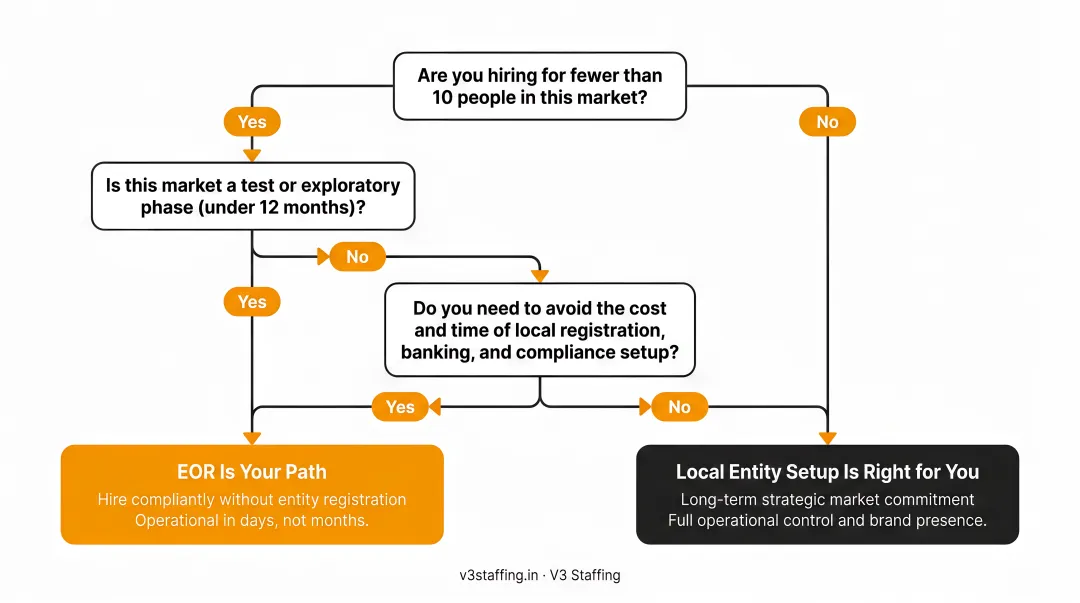
Certain regulated sectors present hard limits that the EOR simply cannot clear on the client's behalf:
- UK financial services: Requires FCA authorisation before conducting regulated activities
- Healthcare in England: CQC registration is mandatory before providing regulated services
- RBI-regulated activity in India: May require NBFC registration depending on scope
The EOR manages employment administration. Sector-specific regulatory approvals remain the client's responsibility to obtain before operations begin.
Conclusion
EOR compliance is a layered, ongoing process—not a checkbox. It spans legal entity registration, contract localization, payroll and tax accuracy, statutory benefits administration, data privacy obligations, and continuous regulatory monitoring across every country where an employee is hired.
Understanding the mechanics, not just the concept, is what allows companies to choose the right partner, avoid hidden liability, and scale international hiring confidently.
The difference between nominal EOR coverage and genuine compliance protection comes down to in-country expertise: direct entity presence, real-time regulatory tracking, and deep familiarity with the labor law landscape where your employees actually work.
V3 Staffing's 15+ years of compliance and regulatory expertise across India's major hiring markets—covering PF, ESIC, professional tax, gratuity, maternity leave, and state-level labor law variations—demonstrates that depth in practice, for enterprises and GCCs building teams across multiple Indian states.