
.svg)
.svg)
Introduction
Every HR leader eventually faces the same crossroads: you know you need to hire, but you're not sure whether to bring in a long-term recruitment partner or engage an agency to fill roles fast. Get that decision wrong, and you're looking at blown timelines, inflated costs, and talent that doesn't stick.
RPO and contingent recruitment are distinct approaches to talent acquisition — not variations of the same thing. One is a strategic operating model built into your hiring infrastructure; the other is a transactional service activated role by role. Choosing between them based on price alone, or familiarity, often leads to a mismatch that costs far more than the placement fee.
The stakes are real. According to Grand View Research, the global RPO market was valued at USD 7.33 billion in 2022 and is projected to reach USD 24.32 billion by 2030 — a 16.1% CAGR. That growth reflects a shift in how serious organizations are approaching structured, scalable hiring.
This article breaks down how each model works, where each one fits, and how to decide which is right for your organization.
Key Takeaways
- RPO is a long-term, embedded partnership; contingent recruitment is pay-per-hire and transactional
- RPO suits high-volume, ongoing, or strategically critical hiring; contingent works for urgent, one-off roles
- SHRM reports total hiring costs can reach 3–4x a role's salary — so choosing the right model matters
- Cost structures differ: RPO uses a management fee model; contingent charges 20–33% of first-year salary on placement
- Many organizations use both models together — RPO for ongoing hiring, contingent for one-off roles
RPO vs. Contingent Recruitment: Quick Comparison
Here's how the two models stack up across the factors that matter most to hiring decisions:
| Factor | RPO | Contingent Recruitment |
| Cost Structure | Predictable management or subscription fee | Fee (20–33% of salary) paid only on successful placement |
| Engagement Model | Long-term, embedded partnership | Short-term; ends when the role is filled |
| Recruitment Approach | Proactive — pipeline building before need arises | Reactive — sourcing begins after vacancy opens |
| Scalability | Built for high-volume, multi-role programmes | Best for isolated vacancies; scaling requires multiple agencies |
| Accountability | Formal SLAs covering time-to-fill, quality-of-hire, and retention | Minimal post-placement accountability; typically a replacement window |
| Employer Brand | Consistent brand representation across all touchpoints | Variable; speed often takes priority over brand alignment |
What Is RPO?
Recruitment Process Outsourcing (RPO) is a model where an external provider takes over all or part of an organisation's internal recruitment function. The provider doesn't sit outside, sending CVs over a wall — they embed into the HR team and operate as an accountable extension of it.
As defined by the Recruitment Process Outsourcing Association, RPO is a form of business process outsourcing where an employer transfers all or part of its recruitment processes to an external service provider. Gartner similarly frames RPO providers as third-party specialists who partner with organisations across all aspects of recruitment.
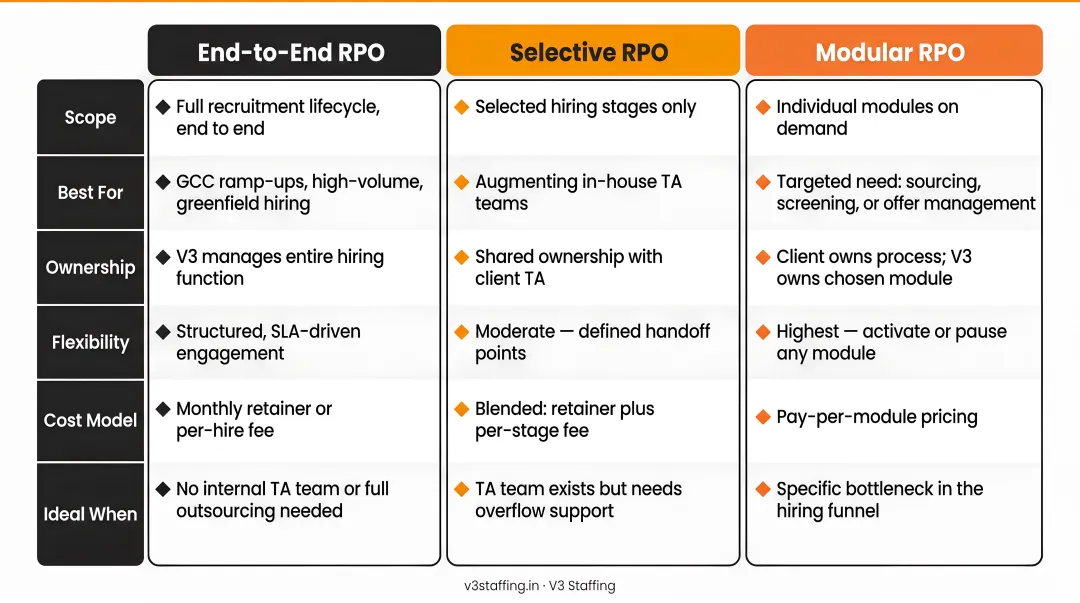
The Three Core RPO Models
End-to-end RPO: The provider manages the full hiring lifecycle across all roles, business units, and locations — replacing or integrating with internal recruitment resources entirely.
Project RPO: A time-bound engagement for defined hiring campaigns. Useful when a specific push (say, 100 engineers in 12 months) exceeds internal capacity.
Selective/modular RPO: The provider augments specific stages — sourcing only, or screening only — without owning the full function. Organisations with partial internal capability use this to fill gaps without a full handover.
What RPO Tracks
RPO providers are accountable through formal SLAs. According to RPOA, standard RPO success metrics include:
- Time-to-accept, time-to-present, and time-to-start
- Requisition aging and pipeline health
- Quality of applicants, candidates, and employees
- Retention rates, performance scores, and tenure
Use Cases for RPO
RPO works best for organisations with sustained, high-volume hiring needs — large enterprises scaling new business units, GCCs building out tech teams across India, or companies standardising hiring across multiple locations.
India's GCC sector illustrates the scale of the challenge well. According to Deloitte, India had over 1,700 operating GCCs by FY24, employing over 1.9 million professionals — with projections showing over 2,400 GCCs by 2030. Hiring at that scale through fragmented agency recruitment would be inconsistent and costly. RPO provides the infrastructure to keep up.
V3 Staffing's RPO model operates on an embedded-team structure with SLA-driven shortlists and rigorous screening across skills, stability, and cultural fit. One documented engagement involved sourcing approximately 1,000 software engineers for a Fortune 500/FTSE 100 client within a 12-month timeline — a scale well beyond what contingent recruitment could absorb.
What Is Contingent Recruitment?
Contingent recruitment (also called contingency recruiting or contingency search) is a model where an agency is paid only when they successfully place a candidate. No placement, no fee. That makes it a zero-upfront-cost arrangement for the hiring company.
BambooHR defines contingency recruiters as those paid only after finding a candidate who accepts a job offer — making the model straightforward: risk sits with the agency, not the employer, until a hire is made.
In practice, contingent recruiters work in a competitive, open-market environment. Multiple agencies may work the same role simultaneously, racing to submit candidates first. That speed pressure can be useful — but it often pushes depth of search and candidate quality to the background.
That competitive structure also shapes the relationship itself. Once the role is filled, the engagement ends — with no ongoing accountability, no pipeline for future roles, and no real investment in understanding the organization's broader talent direction.
Use Cases for Contingent Recruitment
Contingent recruitment delivers genuine value in specific situations:
- Urgent single hires where speed is the priority and the role is well-defined
- Niche or specialised roles where you need a recruiter who already has the right network
- Short-term or contract positions where a permanent hire isn't the goal
- Testing a recruiter's effectiveness before committing to a deeper engagement
- Early-stage organisations that lack the hiring volume to justify an RPO model
Startups, leaner organizations, or established companies filling an isolated senior role outside their normal hiring cadence often get strong results from contingent recruitment — precisely because they need speed and don't need infrastructure.
Key Differences Between RPO and Contingent Recruitment
Cost and Financial Risk
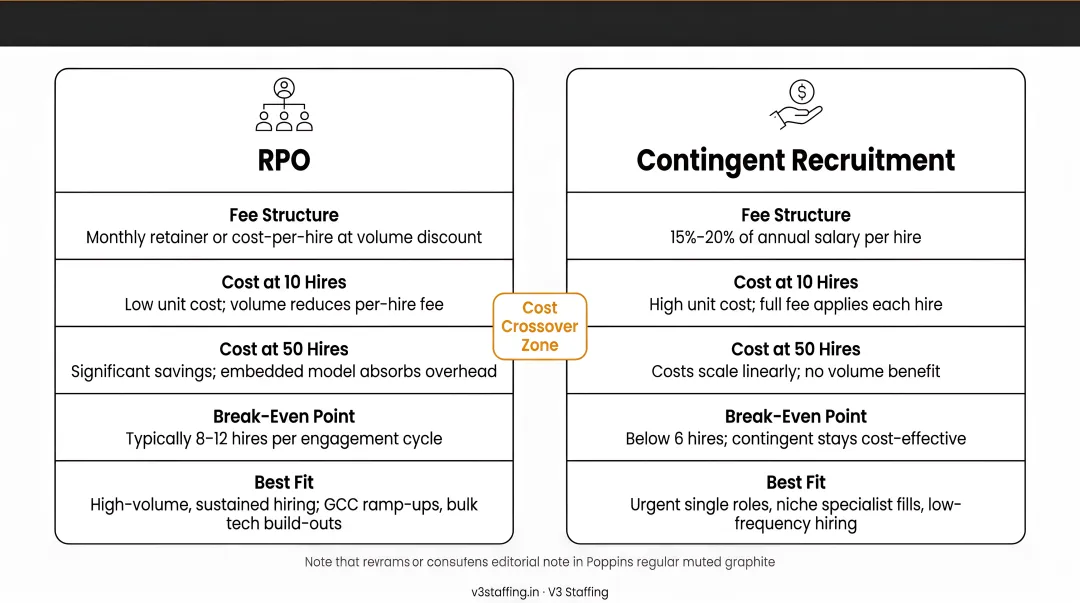
Contingent recruitment feels low-risk because there's no fee unless someone is hired. But that fee is significant. SHRM puts the range at 20–33% of a new employee's first-year salary. At scale, those per-placement costs accumulate fast.
RPO works differently: costs are spread across an ongoing service model. RPOA's pricing guidance confirms that RPO cost-per-hire improves as hiring volume increases — meaning the economics get better as your hiring program grows, while contingent fees stay proportional to salary regardless of volume.
Accountability and SLAs
RPO providers operate under formal service-level agreements with defined KPIs — time-to-fill, quality-of-hire, candidate satisfaction, retention rates. There's structured, ongoing accountability.
Contingent agencies typically offer a replacement guarantee if a hire leaves within a set window — often 90 days, sometimes extending to 180 days. Beyond that: no funnel visibility, no quality reporting, no ongoing commitment.
Employer Brand Impact
Every candidate interaction is a brand touchpoint. RPO providers represent the hiring company's identity consistently across the full hiring lifecycle — because they're embedded as part of the team.
Contingent recruiters, working across multiple clients and under time pressure, often prioritise getting a CV submitted over ensuring the candidate has a coherent picture of who they're joining. That can result in an impersonal or inconsistent candidate experience that reflects poorly on the employer.
Pipeline vs. Point-in-Time Sourcing
The sourcing approach differs sharply:
- RPO builds evergreen talent communities, with outbound engagement continuing between active hiring cycles — so when a role opens, warm candidates are already in the pipeline.
- Contingent recruitment starts from scratch every time. No prior candidate relationships, no institutional knowledge of what worked last time.
Depth of Fit Assessment
Because RPO teams are embedded and measured on long-term quality metrics — retention, performance, cultural fit — they invest more time evaluating whether a candidate will genuinely succeed in the role, not just whether they match the job description.
Contingent recruiters are incentivised by placement speed. A candidate who fills the spec and accepts an offer counts as a win, even if they leave six months later.
At a Glance: RPO vs. Contingent Recruitment
| Dimension | RPO | Contingent Recruitment |
| Cost structure | Ongoing service fee; improves at scale | Per-placement fee (20–33% of first-year salary) |
| Accountability | Formal SLAs with KPIs | Replacement guarantee only (90–180 days) |
| Employer brand | Consistent, embedded representation | Variable; candidate experience can suffer |
| Talent pipeline | Evergreen communities built over time | Search starts fresh with each vacancy |
| Fit assessment | Evaluated on retention and performance | Optimised for placement speed |
Which Recruitment Model Is Right for Your Organisation?
Choose RPO if:
- Your organization hires consistently at volume — multiple roles, multiple locations, ongoing demand
- You want scalable talent acquisition infrastructure, not just individual placements
- Employer branding, quality-of-hire analytics, and SLA-backed accountability matter to your HR strategy
- You're building a long-term talent pipeline — for example, a GCC scaling its India operations or a large enterprise standardising hiring across business units
Choose Contingent Recruitment if:
- You need to fill a single urgent vacancy quickly
- The role requires a specialist recruiter with a specific network you don't have access to internally
- You're in early-stage growth with unpredictable or low hiring volumes
- You want to test a recruiter's performance before making a deeper commitment
Using Both Together
Most organizations don't choose just one model. RPO handles the core hiring program — volume roles, multi-location mandates, ongoing pipelines — while contingent recruitment fills isolated gaps, executive searches, or highly specialized roles that fall outside the RPO scope.
The two work well in combination. You get structural efficiency for the bulk of your hiring, plus the flexibility to move fast on one-off roles without disrupting the RPO engagement.
Conclusion
There's no universal winner here. RPO delivers consistent, scalable, and strategically aligned hiring for organizations with sustained talent needs. Contingent recruitment remains a practical tool for urgent, isolated, or highly specialised roles. The real decision is knowing which context you're actually in.
As hiring complexity grows — especially for large enterprises, GCCs, and product organizations managing multi-location teams — the shift toward structured, outcome-driven recruitment models becomes harder to avoid. Ad-hoc hiring carries real costs that compound at scale:
- Doesn't build talent pipelines for future roles
- Erodes employer brand through inconsistent candidate experience
- Costs more per hire than most organizations recognize until volume adds up
If you're weighing which model fits your current hiring goals, V3 Staffing works with large enterprises, GCCs, and product organizations across India, the US, and the Middle East — across both RPO and permanent placement models. Connect with the team to explore what makes sense for your organisation's scale, pace, and talent strategy.