
.svg)
.svg)
Introduction
Hiring the wrong person is expensive. Hiring the right person too slowly costs just as much. SHRM's 2025 benchmarking data puts the average cost-per-hire at $5,475 for non-executive roles and $35,879 for executive positions — and that's before factoring in the cost of a wrong decision. Replacing an employee who doesn't work out can run 50–200% of their annual salary, according to SHRM.
For enterprises, GCCs, and product organizations navigating headcount uncertainty alongside demand for specialized talent, choosing between contract-to-hire (C2H) and direct hire has real consequences — it directly shapes speed-to-fill, budget exposure, and long-term team quality.
What follows is a clear breakdown of both models — how they work, where each one wins, and how to match the right approach to your specific role and business context.
Key Takeaways
- Contract-to-hire reduces upfront commitment by letting employers evaluate real-world performance before converting to permanent employment
- Direct hire accelerates cultural integration and is the stronger choice when immediate accountability or organizational authority is needed from day one
- First-year attrition accounts for roughly 40% of all turnover — making the evaluation runway in C2H genuinely valuable for high-risk roles
- Neither model is universally superior; the right choice depends on role criticality, budget flexibility, and what the talent market will accept
- High-performing organizations typically run both models in parallel — C2H for exploratory or high-risk roles, direct hire for leadership and core teams
Contract-to-Hire vs Direct Hire: Quick Comparison
| Dimension | Contract-to-Hire | Direct Hire |
| Time to Fill | Faster; agency pre-screens candidates | Slower; multi-stage search and negotiation |
| Upfront Cost | Lower; agency covers payroll and benefits during contract | Higher; full compensation and onboarding from day one |
| Hiring Risk | Lower; performance validated before permanent offer | Higher; assessment relies on interviews alone |
| Flexibility | High; contract can end or extend as needed | Low; exits involve severance and notice periods |
| Candidate Pool | Slightly narrower; some candidates prefer permanent roles | Broader; permanent offers attract the full market |
| Best For | New roles, uncertain headcount, hard-to-assess soft skills | Core functions, leadership, roles needing immediate commitment |
What is Contract-to-Hire?
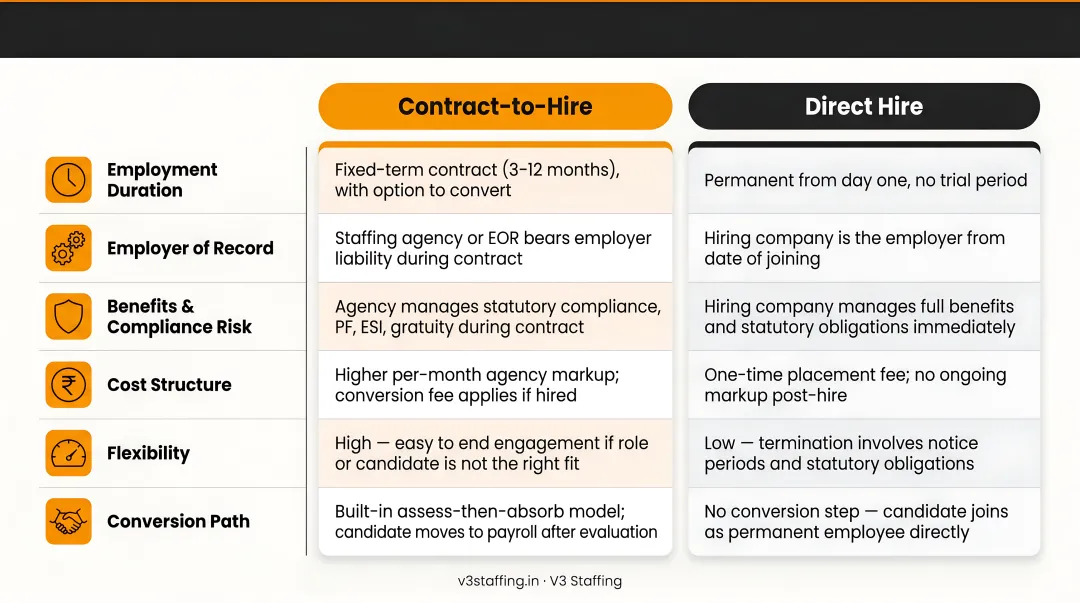
Contract-to-hire places a candidate on a staffing agency's payroll for a defined period — typically 3–12 months — embedded within the client organization's team. The contractor is not on the employer's payroll during this phase; the agency carries that obligation.
At the end of the contract term, the employer decides whether to convert the contractor to a permanent employee. That decision happens with months of real working data behind it — not just interview impressions.
The "Try Before You Buy" Advantage
Employers assess real-world performance before making a permanent commitment. How someone writes code in production, collaborates under deadline pressure, or navigates internal stakeholders tells you far more than any interview.
This works both ways. Candidates also evaluate the company's leadership style, culture, and team dynamics before committing long-term — which often leads to higher satisfaction when conversion does happen.
According to the American Staffing Association, one-third of temporary and contract employees are offered permanent positions by client companies, and two-thirds of those accept. That's a meaningful conversion signal — these aren't arrangements that routinely fail to convert.
Financial Structure During the Contract Phase
During the contract period, the staffing agency absorbs:
- Payroll taxes and statutory contributions
- Benefits and workers' compensation equivalents
- Compliance obligations under applicable labor law
For employers, this means lower upfront financial exposure compared to a direct hire, where the full cost of employment begins on day one.
The Risk You Can't Ignore
Strong candidates in high-demand skill areas — senior engineers, data scientists, niche specialists — frequently have multiple offers in play. If a competitor extends a permanent offer while your contractor is mid-engagement, you can lose them. The lesson: don't wait for the formal contract end date. When a contractor proves exceptional, move to convert early.
Use Cases for Contract-to-Hire
C2H delivers the most value for:
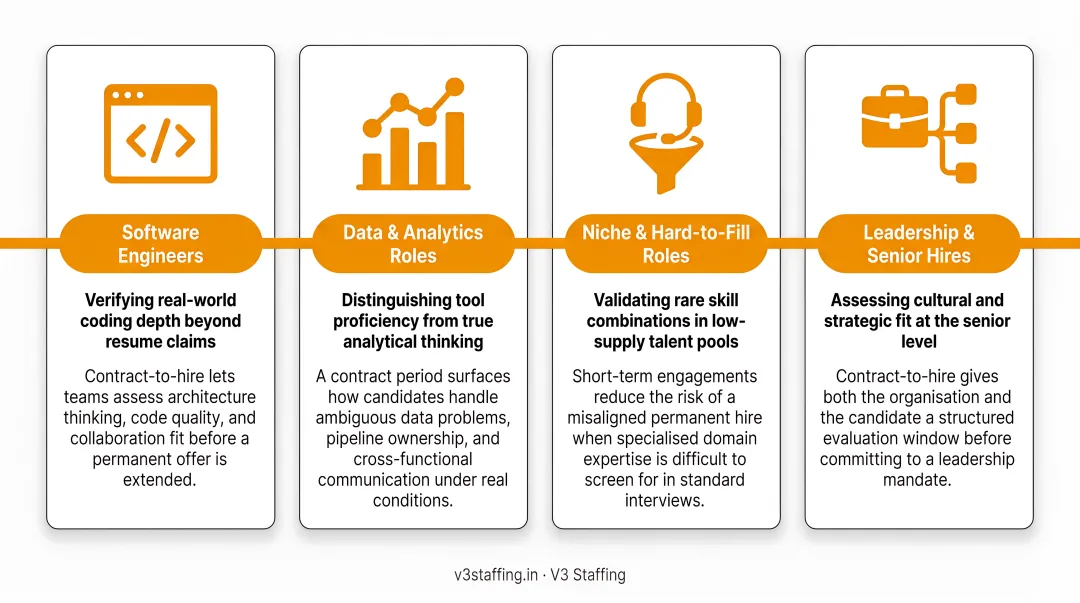
- Software developers and engineers — real code quality and production behaviour matter more than whiteboard performance
- Data and analytics roles — where methodology and judgment only emerge through actual project work
- Marketing and creative positions — brand judgment, collaboration style, and taste are nearly impossible to assess in interviews
- Newly created or undefined roles — where scope may evolve and the success benchmark isn't yet established
For enterprises and GCCs running high-stakes hires, V3 Staffing's contract-to-hire model combines pre-vetted pipelines with structured onboarding — typically getting contractors productive within 48–72 hours of placement.
What is Direct Hire?
Direct hire places a candidate as a permanent, full-time employee from the first day of employment. The employer owns the entire employment relationship — payroll, benefits, statutory compliance, and cultural integration — from the moment the offer is accepted. There's no agency buffer, no trial runway, and no exit ramp without real cost.
Why Direct Hire Works for the Right Roles
When both employer and employee have made a full commitment, integration happens faster. Direct hires develop institutional knowledge more deeply and invest in long-term stakeholder relationships. They also develop a feel for how the business actually operates — the informal dynamics and institutional context that contractors rarely accumulate, even on long assignments.
BLS data from January 2024 puts median tenure at 3.9 years across all wage and salary workers, rising to 4.8 years for management, professional, and related occupations. For computer and mathematical roles specifically, it's 4.3 years. These are the tenure windows where institutional knowledge genuinely compounds — and they're more reliably achieved through direct hire.
Onboarding quality matters here too. SHRM research shows that structured onboarding makes employees 58% more likely to remain for three years and can make new hires 50% more productive faster. That investment pays off when the hire is permanent from day one.
The Cost and Risk Tradeoff
Direct hire costs more upfront:
- Full compensation package begins immediately
- Benefits, onboarding, and potential signing bonuses add to first-year outlay
- Staffing Industry Analysts reports the most common direct-hire agency fee is 20% of salary
The real risk is that there's no built-in evaluation period. Misaligned hires in direct placements surface slowly — and by the time performance gaps become undeniable, months of salary, management time, and team disruption have already accumulated.
Use Cases for Direct Hire
Direct hire is the right model for:
- Senior and executive leadership — C2H (contract-to-hire) candidates in leadership roles often can't project the full authority their position requires when their permanence is in question
- Client-facing roles — positions requiring immediate credibility, accountability, and relationship ownership from day one
- Roles requiring security clearances or specialized licensing — where onboarding complexity makes short-term arrangements impractical
- Core business functions — where deep institutional knowledge built over years is the point, not just task completion
In highly competitive talent markets, direct hire is often the only viable option. Strong candidates with in-demand skills typically won't engage with anything less than a permanent offer — and forcing a C2H structure in those situations narrows the pipeline to candidates who couldn't land a permanent role elsewhere.
Which Staffing Model Is Right for You?
Neither model is universally better. The right answer depends on four factors: role criticality and permanence, budget and headcount flexibility, urgency, and the cost your organization can absorb if the hire doesn't work out.
When to Choose Contract-to-Hire
Consider C2H when:
- The role is newly created with no established benchmark for success
- The organization is in a growth or funding phase with uncertain headcount approval
- The role involves skills that are easy to claim but hard to verify without real work (most technical roles fall here)
- The team has historically struggled with cultural fit in this function
When to Choose Direct Hire
Choose direct hire when:
- The role requires immediate and full authority from day one — leadership and senior management positions especially
- Long-term retention delivers more value than short-term cost savings
- The role carries direct client or market-facing responsibility from the outset
- The talent market for this skill set is competitive enough that top candidates won't engage without a permanent offer
The Dual-Model Reality for Enterprises and GCCs
Large organizations don't choose one model across the board. Running both models simultaneously across different functions is the more common — and more effective — approach.
Consider a practical scenario: a GCC scaling its engineering team in Bengaluru is operating under uncertain FY headcount approval. The finance function won't greenlight permanent headcount until Q3, but the product roadmap needs engineers in Q1.
Contract-to-hire lets the GCC place technically vetted engineers immediately, absorb them into the team's delivery rhythm, and convert them once headcount approval clears — without stalling the roadmap or making permanent commitments the budget doesn't yet support.
Meanwhile, that same GCC is hiring a Head of Engineering through direct hire, because a leader whose permanence is ambiguous can't build a team, drive roadmap decisions, or negotiate cross-functionally with full authority.
According to Deloitte, contingent workers increasingly constitute 30–50% of overall workforces — meaning the dual-model approach isn't a workaround; it's standard workforce architecture at scale.
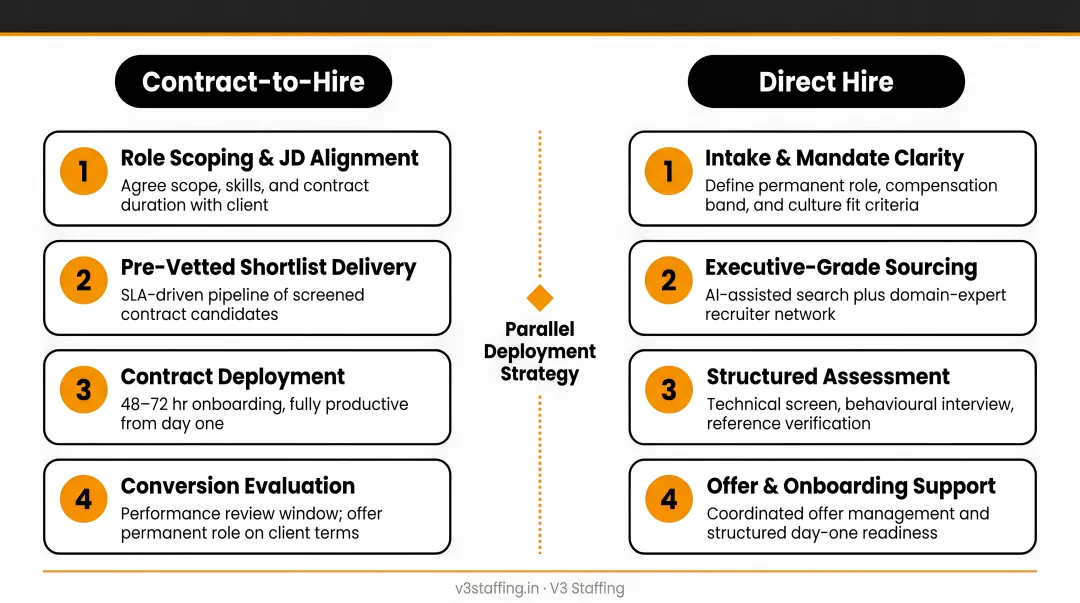
Workforce planning teams that build this dual-model discipline can manage headcount risk without stalling growth. The practical discipline is mapping each open role to a model before the search begins — not after the first candidate clears screening.
V3 Staffing has helped enterprises and GCCs make this call across hundreds of roles, applying 15+ years of placement experience across India's major business hubs to match the right model to each position from the start.
Conclusion
Contract-to-hire and direct hire serve different purposes — and the right choice depends on three things: how much hiring risk the organization can carry on a given role, how quickly the business needs the person fully productive and committed, and what the talent market for that skill set will actually accept.
The stakes are real. Choosing the wrong model costs money, yes — but it also costs time, team morale, and momentum that's hard to recover mid-quarter.
A quick decision guide:
- Short runway or unclear scope? Contract-to-hire reduces commitment risk while you validate fit.
- Critical, long-term role with competitive demand? Direct hire signals commitment and attracts candidates who won't engage on a trial basis.
- Unsure which the market will accept? That's where a staffing partner with live market data earns its value.
Treating staffing model selection as a role-specific decision — not a blanket policy — is what separates organizations that fill roles fast from those that refill them twice.