
.svg)
.svg)
Introduction
Hiring AI talent in the US has become genuinely difficult. According to the World Economic Forum, 94% of leaders report AI-critical skills shortages, with roughly one-third facing gaps of 40–60% in key AI roles. Senior ML engineers command average base salaries of $165,000–$214,000 in the US, and positions often sit open for months.
That shortage is driving US enterprises, GCCs, and product organizations toward India — and for good reason. India holds the 2nd-largest AI and ML talent pool globally and ranks 1st in AI skill penetration. With over 1,700 GCCs already operating there, the infrastructure and precedent are firmly in place.
This guide walks through the full process — from scoping roles and choosing engagement models to governance, hiring, and keeping the team intact once it's running.
Key Takeaways
- India's AI talent pool is large, English-proficient, and significantly cheaper than equivalent US hiring.
- Building a functional offshore AI team requires defined roles, a matched engagement model, and structured governance — not just sourcing.
- Underspecifying scope and using project-based contracts are the two most common early mistakes in iterative AI work.
- Compliance groundwork (NDAs, data processing agreements, DPDP Act alignment) must be in place before any data access begins.
- Treat this as a long-term strategic partnership, not a cost-cutting exercise.
What Is an Offshore AI Team?
An offshore AI team is a group of specialized professionals — Data Scientists, ML Engineers, MLOps Specialists, and Data Engineers — based in another country (typically India for US companies) and working as an integrated extension of the client's internal team.
This is meaningfully different from generic software outsourcing. Standard software projects deliver defined outputs: a feature, a module, a codebase.
AI development is continuous. Models degrade due to data drift, require retraining, and need ongoing monitoring — which makes team composition and governance far more complex than a typical offshore engagement.
Three Common Structures
| Model | Best For | Key Trade-off |
| Dedicated Team | Long-term, iterative AI development | Higher commitment, maximum control |
| Staff Augmentation | Filling specific skill gaps in an existing team | Flexible, but requires internal coordination |
| Build-Operate-Transfer (BOT) | Enterprises planning a permanent offshore AI center | Longer timeline, but ends with full ownership |
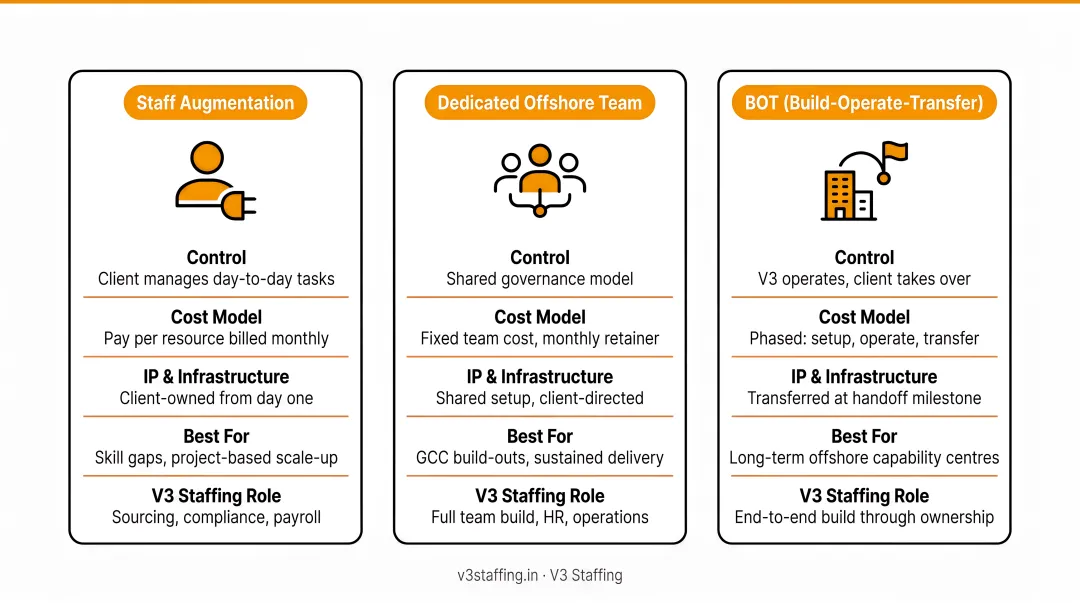
Each model carries different implications for cost, IP ownership, and management overhead — factors covered in depth later in this guide.
What to Know Before You Build
AI Is an Ongoing Lifecycle, Not a Project
Models don't stay accurate after deployment. Data distributions shift, business contexts change, and model performance degrades over time. Planning for an "initial build" without budgeting for retraining, monitoring, and governance is one of the most common — and expensive — mistakes organizations make.
Before hiring anyone, get internal alignment on two questions: Is there ongoing operational investment committed beyond launch? And who owns model performance once the team is in place?
Compliance and IP Groundwork
This step cannot happen in parallel with hiring — it needs to come first. The non-negotiables:
- NDAs and IP assignment clauses for all team members, signed before any project context is shared
- Data Processing Agreements (DPAs) covering how training data is handled, stored, and accessed
- Cross-border data transfer rules — India's Digital Personal Data Protection (DPDP) Act 2023 permits transfers outside India unless the Central Government restricts specific countries; full compliance timelines under the DPDP Rules 2025 run through May 2027
- Sector-specific requirements — HIPAA, GDPR, and financial data standards need to be mapped before granting dataset access
Getting this groundwork right before your first hire avoids rework, protects your IP, and keeps data access from becoming a blocker mid-project.
Why Build an Offshore AI Team?
When It Makes Strategic Sense
Three conditions need to be true:
- Local AI talent is unavailable, slow to hire, or cost-prohibitive at scale
- The AI initiative is a sustained roadmap — not a single experiment
- Your organization has internal bandwidth to manage a distributed team
The cost difference is significant. A Senior ML Engineer in the US earns an average base salary of $165,179 (PayScale) to $214,735 (Glassdoor). A comparable senior ML role in India runs approximately INR 27–37 lakh per year (roughly $32,000–$45,000).
| Role Level | US Salary (avg) | India Equivalent | Approximate Savings |
| Senior ML Engineer | $165K–$215K | $32K–$45K | 70–80% |
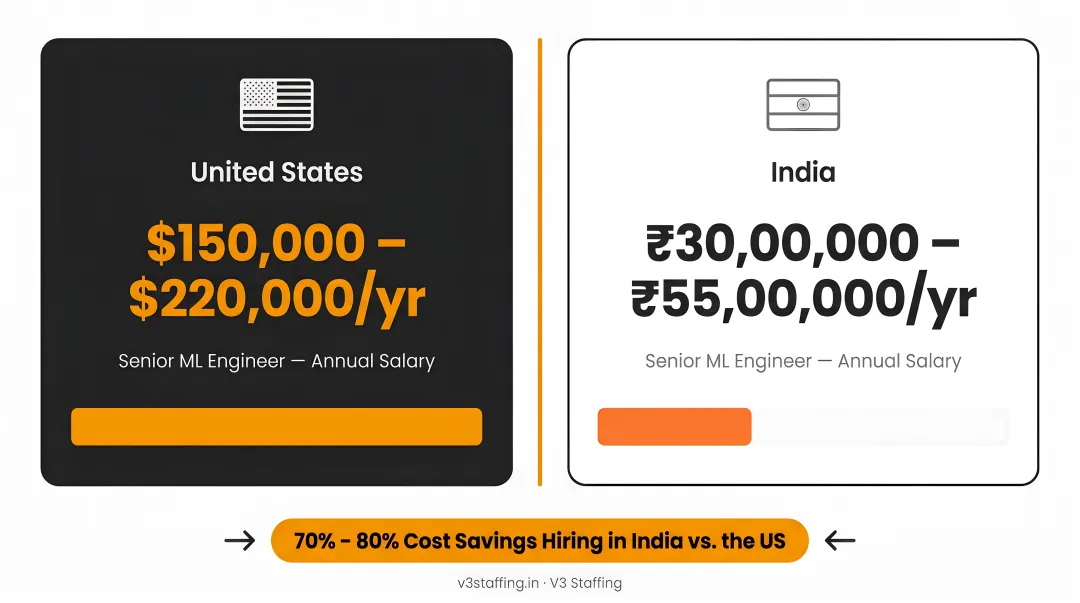
Exact savings vary by seniority, role type, and engagement structure — but the directional advantage is consistent.
Where Offshore AI Teams Add the Most Value
- US enterprises scaling GCC operations — India hosts 1,800+ GCCs today, with plans to reach 5,000, meaning talent ecosystems, legal infrastructure, and management playbooks are already mature
- Product companies running continuous development — follow-the-sun teams across India and the US enable near-continuous iteration without forced overtime
- Organizations sourcing niche AI skills — NLP, computer vision, and generative AI talent that's nearly impossible to hire locally at scale
Where It May Not Be Right Yet
- Early-stage startups without defined AI use cases
- Companies without any internal AI oversight capability
- Projects involving highly sensitive regulated data where compliance infrastructure isn't ready
How to Build an Offshore AI Team – Step by Step
Most early-stage failures trace back to three causes: rushing to hire before defining scope, underestimating the difference between AI and standard software work, and choosing cost over capability when selecting a partner.
Step 1 – Define Your AI Goals and Project Scope
Start with the specific business problem AI will solve. Customer churn prediction, document processing automation, and supply chain optimization each require different data, different model types, and different infrastructure. Translate the use case into measurable outcomes:
- Target model accuracy or F1 score
- Latency requirements for inference
- Deployment timeline
- Expected retraining frequency
Then decide whether the team will focus on model development, data engineering, MLOps, or a combination — because that determines roles, seniority, and tooling needs. "We need AI talent" is not a sufficient brief. A written AI project charter shared with your talent partner reduces hiring mismatches before sourcing even begins.
Step 2 – Identify the Roles Your Team Needs
A functional offshore AI team typically includes:
| Role | Core Responsibility |
| Data Scientist | Model design, experimentation, evaluation |
| ML Engineer | Productionizing models, performance optimization |
| Data Engineer | Pipelines, ETL, feature stores |
| MLOps Specialist | CI/CD for ML, drift detection, model monitoring |
| AI/ML Project Manager | Sprint governance, cross-team coordination |
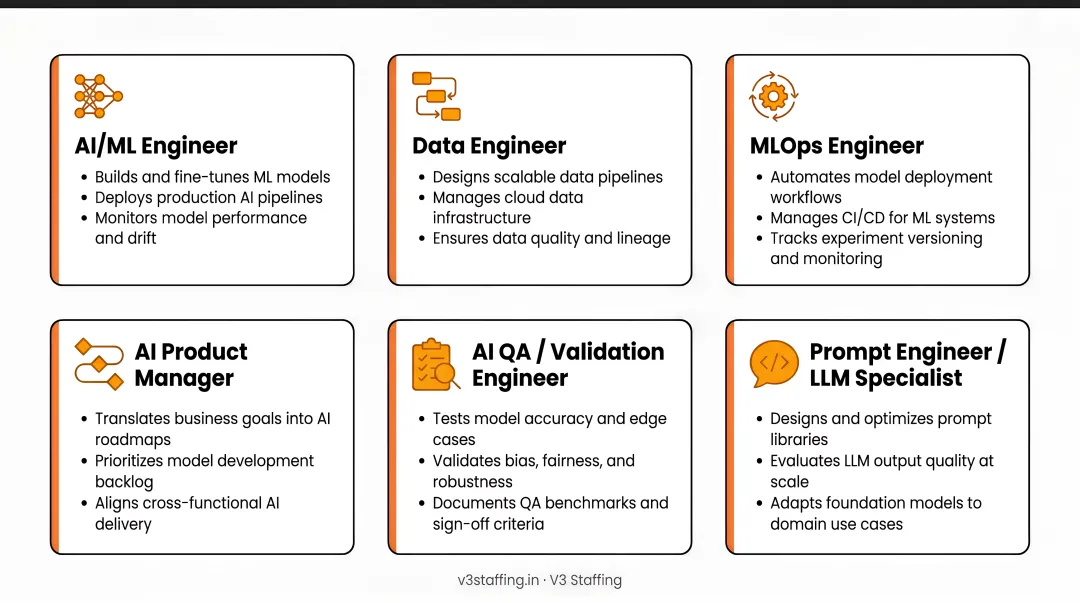
Team size depends on project phase. A 3–5 person team is appropriate for early validation. An enterprise-grade initiative typically needs 8–12 specialists with clearly separated responsibilities. A 60:40 senior-to-mid-level ratio is a reasonable starting benchmark.
For generative AI or LLM-related work, Prompt Engineers and AI Integration Specialists are increasingly required. Hire these to match current project needs — not speculatively.
Step 3 – Choose the Right Engagement Model
The most common mistake here: defaulting to project-based or fixed-scope contracts for work that is fundamentally iterative. AI systems need ongoing maintenance and retraining. Fixed-scope contracts create friction and scope creep within three to six months.
- Dedicated Team: Best for long-term, iterative AI development where IP control matters
- Staff Augmentation: Best for filling specific skill gaps in an existing team; lower overhead, but internal coordination sits with you
- BOT (Build-Operate-Transfer): Best for enterprises building a permanent offshore AI center; longer runway that ends with full ownership
The choice affects cost structure, IP assignment, and how much day-to-day management sits on the client side.
Step 4 – Select the Right Talent Partner
Not all staffing partners have genuine AI depth. When evaluating, focus on:
- AI-specific placement experience: Domain knowledge matters. A generalist recruiter sourcing ML engineers will miss signals that a specialist catches early
- Candidate vetting rigor: Technical assessments, stability screening, and culture-fit checks — not just resume filtering
- SLA commitments on shortlist delivery timelines
- Compliance expertise: Cross-border data handling, NDA protocols, and DPDP Act alignment
- Geographic coverage across India's major AI talent hubs: Bengaluru, Hyderabad, Pune, Chennai, Delhi NCR, and Mumbai
V3 Staffing has built active hiring networks across all six of these cities through 15 years of operations, supporting large enterprises and GCCs with structured onboarding and SLA-driven delivery. Their client roster includes Google, FactSet, DuPont, Johnson Controls, and Dream11 — organizations where hiring quality and speed both matter.
Red flags to watch for:
- No AI-specific placement track record
- Unable to provide references in your industry
- Opaque pricing or unclear IP and data protection protocols
Step 5 – Set Up Communication and Collaboration Frameworks
Define tooling and cadence before the team starts:
- Async updates: Slack or Microsoft Teams for daily status
- Sprint tracking: Jira or Trello for task management
- Experiment tracking: MLflow or Weights & Biases
- Code collaboration: GitHub or GitLab
- Synchronous reviews: Zoom or Google Meet for sprint reviews and retrospectives
Governance needs to be established from day one, not after something goes wrong. Document roles and escalation paths, set sprint-level KPIs (model accuracy targets, deployment frequency, bug rates), and maintain a living project wiki in Confluence or Notion.
The structure matters beyond tooling. HBR research on distributed teams found that high-performing remote teams communicate in concentrated bursts — rapid exchanges followed by focused work periods — rather than constant interruption.
Step 6 – Onboard, Measure, and Scale
Structured onboarding reduces the time-to-productivity gap significantly:
- Week 1 — Introduce offshore members to company culture, AI infrastructure, and data access protocols
- First 30 days — Assign an onshore mentor; complete domain-specific compliance training (HIPAA, GDPR, sector-relevant standards) before any sensitive dataset access
- Ongoing — Track performance across two dimensions: team effectiveness (sprint velocity, on-time delivery, communication responsiveness) and model outcomes (accuracy, latency, deployment frequency, uptime)
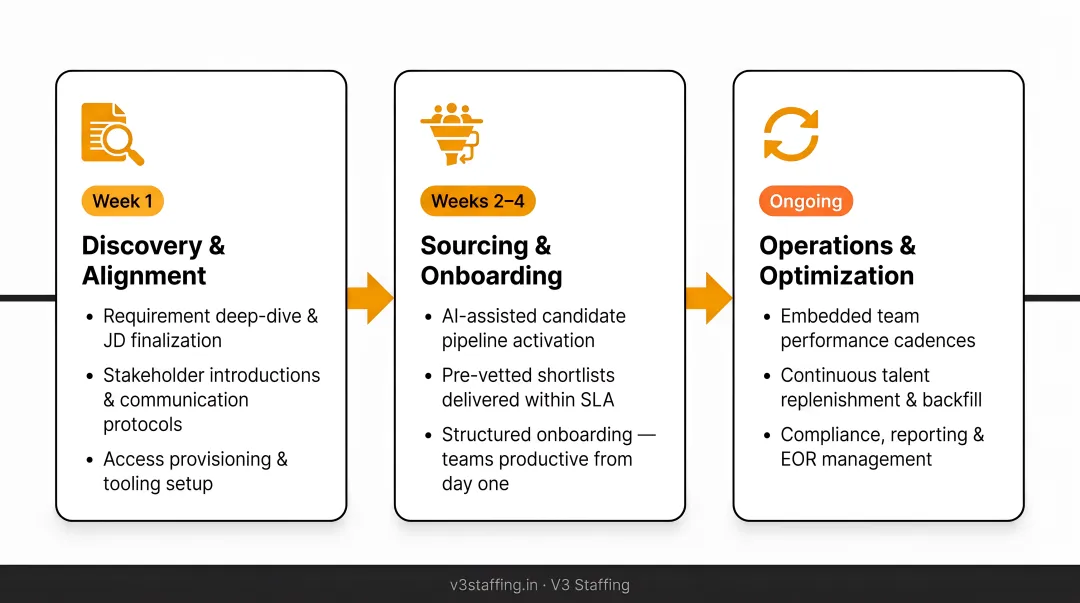
Set a clear review cadence — quarterly assessments work well for evaluating scaling decisions, skill gaps, and restructuring needs.
Managing Your Offshore AI Team for Long-Term Success
Treat the Team as an Extension, Not a Vendor
The offshore teams that perform best are treated as integrated R&D partners. That means including offshore members in design discussions, sharing business context behind model requirements, and recognizing milestones as a unified team.
Gallup's 2024 longitudinal research found that well-recognized employees are 45% less likely to turn over after two years — a number that matters directly in India's competitive AI talent market.
Address Retention Structurally
India's tech attrition rates decreased in 2024 compared to 2023 (per NASSCOM-Deloitte benchmarking), but the AI talent market remains competitive. Retention strategies that work:
- Compensation benchmarked regularly to local market rates
- Defined career paths — not just job titles
- Access to certifications, conferences, and external learning
- Regular structured feedback loops (not ad-hoc annual reviews)
Attrition in a key AI role mid-project is expensive. Build retention into the operating model from the start.
Reduce Maintenance Overhead with MLOps Automation
As the team matures, automated retraining triggers, drift detection pipelines, and ML-specific CI/CD reduce the manual workload on engineers. This shifts team capacity from maintenance toward innovation — where offshore AI teams create the most measurable value.
Measure ROI Beyond Cost Savings
Cost reduction is easy to quantify but incomplete as a success metric. Track:
- How much faster models are reaching production (time-to-market acceleration)
- Accuracy gains across successive model iterations
- Deployment frequency as a signal of operational maturity
- Revenue generated or operational costs cut through AI features
Conclusion
Building a high-performing offshore AI team in India is a structured process. Clarity of scope, the right roles, a trusted talent partner, and disciplined governance matter more than speed of hiring. Organizations that treat this as a cost-cutting shortcut tend to run into the same problems — IP gaps, scope creep, and teams that never reach full productivity.
For US enterprises, GCCs, and product organizations ready to move from AI ambition to AI execution, India's talent depth paired with the right staffing partner shortens timelines and reduces hiring risk significantly.
V3 Staffing brings over 15 years of placement experience across Bengaluru, Hyderabad, Pune, Chennai, Delhi NCR, and Mumbai, with the compliance coverage and domain-specific vetting that AI team builds demand.